
Historic places are not always grand, architecturally distinguished, or immediately recognizable as landmarks. Sometimes their significance comes from the lives lived within them and the memories, relationships, and sense of belonging that accumulate over time.
For Anna Grigorev (Napa High School Class of 2026, who now attends the University of Chicago), the Napa Winery Inn became the place where she developed her confidence, connected with people from around the world, and transformed from a newcomer to someone who truly felt part of the Napa community. Her story reminds us that even unexpected places can become landmarks in someone’s life.
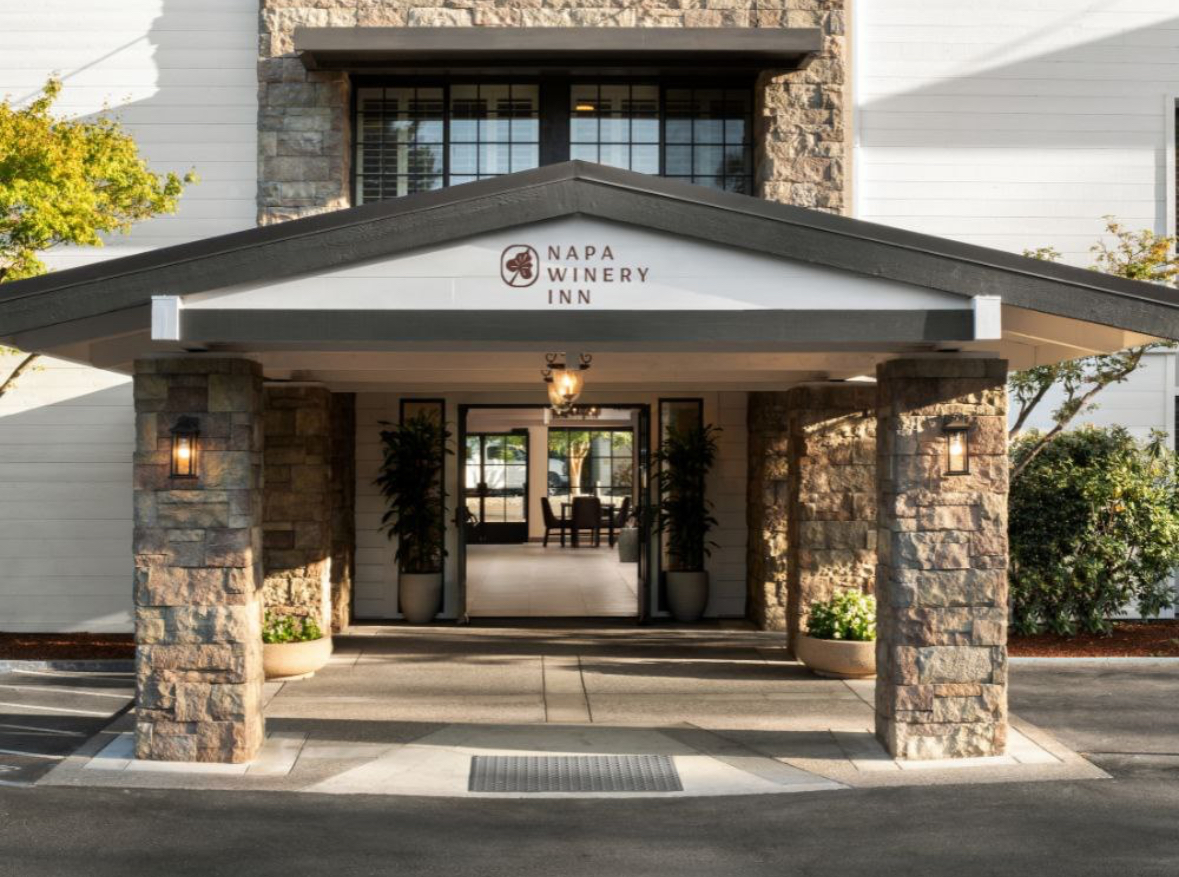
The Napa Winery Inn, by Anna Grigorev
This Napa Valley icon came my way in August of 2024. The Napa Winery Inn is not only a
place to stay overnight and warm up with a cup of coffee in the morning — it is where I
found my voice, connected with cultures, and became a part of the Napa community.
Located just off Highway 29, at 1998 Trower Avenue, the Napa Winery Inn stands as a place
of minimalist splendor — a modern Mecca for tourists planning their overnight stays. Its
low, horizontal structure keeps the building grounded. The exterior combines wooden
panels and stone walls in muted earth tones. Inside, rich wood and simple geometric
elements create a space that feels both refined and expansive.
Yet the significance of this landmark lies beyond its architecture. Though only three stories
tall and over four decades old, the building feels as comprehensive as the world itself,
shaped by the cultures within its walls: 60 rooms filled with travelers from the United
States, France, the Czech Republic, Taiwan, and Ukraine.
Cultural diversity has always been a defining part of my life. When I moved from Russia to
the United States alone five years ago, I learned to navigate colloquial English. However, two
years later, I sought a job that would challenge me to speak with clarity and
professionalism, which I knew I would need for college and a future career in international
relations. Starting as a breakfast attendant and moving up to a front desk receptionist – the
face of the hotel – this part-time job became a milestone.
One interaction, in particular, stayed with me. One afternoon, a couple approached me,
unsure of how to experience Napa beyond wine tastings. Instead of offering a scripted
answer, I recommended my favorite local spots — Veterans Park, Model Bakery, and the
Opera House on Main Street — places where they could truly experience the community. By
the end of our conversation, we had planned their entire stay. In that moment, I realized
how much I’ve grown. I was no longer adapting to a new environment; instead, I now
confidently represented it, guiding others through Napa and sharing its character as
someone who once felt like an outsider.
Moments like these remind me that while Napa Valley is widely known for its wine and
tourism, its true heritage lies in hospitality and connection. The Napa Winery Inn embodies
this tradition. Guests often arrive not just for a room, but for a conversation. Locals stop by
to chat with my coworker, Jeffrey, who has worked here for over 27 years and knows guests
by name. Weekly wine tastings bring together strangers who leave as friends, highlighting
that Napa’s identity is in the relationships it fosters.
Thus, the Napa Winery Inn is more than a workplace to me. It is where I transformed from a
newcomer into a participant in my community. Here, I gained confidence and provided
guidance, fostering a sense of belonging in others. What once was simply a hotel next to my
family’s house became the place where I grew and realized how lucky I am to be part of
such a bright community.